
You're standing in the garage around six in the evening, door's been shut for hours, and you lean back against it and your shoulder practically sizzles. Your spouse says, 'See? This is why we need an insulated door.' You say, 'It's a garage, not a bedroom, why are we paying for insulation out here.' Neither of you actually knows what R-value means. You just know the door is hot enough to fry an egg on, and this isn't the first time you've had this argument.
Here's the plain-language version, so you can settle it once and move on.
What R-value actually means on a garage door
R-value measures how well a material resists heat moving through it. Higher number, slower heat transfer. On garage doors, it's almost always tied to the foam core sandwiched between two steel skins. A non-insulated single-layer steel door is basically R-0 to R-1 — it's just metal, and metal conducts heat fast in both directions. Insulated doors generally fall into two camps: polystyrene-core doors, which land somewhere in the R-6 to R-9 range, and polyurethane-core doors, which are injected foam bonded to the steel and can reach R-12 to R-18+ depending on thickness and construction.
One thing nobody tells you at the showroom: that R-value number describes the panel itself, not your garage as a sealed room. There are still gaps around the perimeter, the bottom seal, and the track where heat sneaks in and out no matter how good the door panel is. An R-18 door doesn't turn your garage into an insulated room — it just slows down how fast heat moves through the biggest single surface in that wall.
Who actually benefits from an insulated door
- Anyone with a shared wall to living space. If a bedroom, laundry room, or home office sits on the other side of the garage wall, an insulated door keeps that wall from acting like a radiator all afternoon.
- Garages used as a workshop, gym, or home office. If you're actually spending time out there, the difference between a bare steel door and an insulated one is the difference between tolerable and miserable by midafternoon.
- Homes where ductwork, a water heater, or an AC unit lives in the garage. Heat soaking through the door raises the ambient temperature around that equipment, which makes it work harder and age faster — not ideal when the dry heat here already shortens the life of mechanical parts.
- Anyone storing things that don't like heat swings. Paint, electronics, pet supplies, musical instruments, anything with rubber seals or batteries degrades faster baking in a 130-degree garage.
Who's paying for nothing
- Detached garages with no shared wall and no climate control. If it's just storage and the door gets opened and closed all day anyway, the heat exchanges constantly regardless of R-value, and you're not buying much comfort for the money.
- Garages used strictly for parking, opened twice a day. The insulation helps a little, but you'll get more day-to-day comfort from better weatherstripping, a reflective coating, and keeping the door sealed tight than from chasing a higher R-number.
- Tight budgets where the real problem is somewhere else. If your garage is miserable because the bottom seal is cracked, the weatherstripping around the frame has gone brittle from UV exposure, or the door doesn't sit flush anymore, an insulated panel won't fix that. Fix the seal first.
The trade-offs nobody mentions
Insulated doors weigh more — sometimes noticeably more, depending on the gauge of steel and foam thickness. That matters because a heavier door needs springs rated for that weight and an opener that can handle the extra load without straining. Given how hard the extreme heat here already works on opener motors, gears, and lubricant, swapping to a heavier door without matching the spring and opener setup to it is how you end up with a opener burning out early or a spring failing months later.
On the upside, insulated doors are almost always built with thicker steel skins, which resist denting and the oil-canning (that rippled, wavy look) that thin steel can develop when it heats and cools repeatedly. They're also noticeably quieter, since the foam core deadens vibration — worth something if the garage sits near a bedroom or you're in and out of it early in the morning.
The desert angle that actually matters
Beyond the core insulation number, insulated doors typically come with a better integrated weatherstripping system around the panels and bottom seal. That matters more here than people expect: monsoon season pushes fine dust and sudden wind-driven rain up against garage doors, and a door with tighter seals keeps more of that dust and water out of the garage floor and stored belongings. It also means less fine grit working its way into tracks and rollers, which cuts down on the grinding noise that shows up a few weeks after a dust storm.
When it's worth calling in a pro
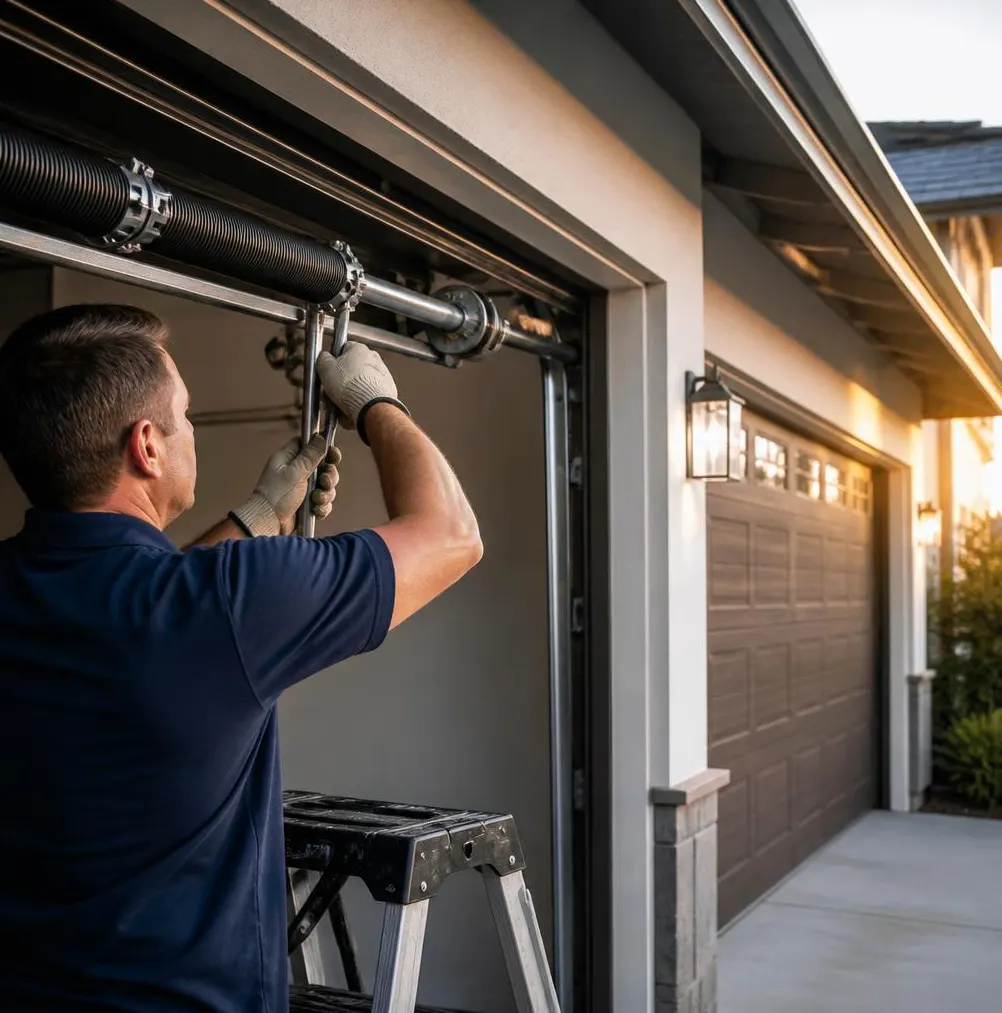
If you've decided an insulated door makes sense for your situation, that's a Garage Door Installation job, not a weekend project — the spring tension and opener strength both need to be matched to the new door's weight, and getting that wrong is how people end up with a door that won't open smoothly or a spring that fails within the year. Fall is actually a good window for this, since technicians aren't working the install in triple-digit heat and you're not left with a half-finished door during a heatwave.
If the real issue turns out to be worn seals, a sagging panel, or a door that's just not closing flush anymore, a Preventive Maintenance visit before next summer is the cheaper fix — tightening hardware, replacing weatherstripping, and re-lubricating everything that the dry heat has already started drying out.
If you're in Surprise, Sun City, Sun City West, Peoria, El Mirage, Buckeye, Waddell, or Litchfield Park and you're ready to settle the argument for good, call Surprise Garage Door Pro. We'll look at your actual garage, tell you honestly whether insulation is worth it for your setup, and handle the installation or the repair either way.